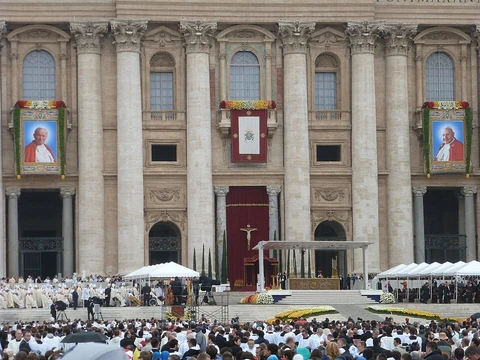
Ignatius of Loyola
Founder of the Jesuits and author of the Spiritual Exercises.

Judgefloro · CC0
Ignatius of Loyola (born Íñigo López de Oñaz y Loyola; c. He is venerated as a saint and is known for his Spiritual Exercises and for leading the Counter-Reformation.
- field
- Catholic priest, theologian
- nationality
- Spanish Basque
- known_for
- Founder of the Society of Jesus (Jesuits), author of the Spiritual Exercises
Lore & Background
Ignatius was born Íñigo López de Oñaz y Loyola in the castle at Loyola, Azpeitia, Gipuzkoa, in the Basque entities of the Crown of Castile. He was the youngest of thirteen children of minor nobility. His mother died when he was about seven years old, and he was raised by his brother's wife and a nurse. The operations left his right leg shorter, ending his military career. During convalescence, lacking romances of chivalry, he read the lives of Christ and the saints, particularly the De Vita Christi of Ludolph of Saxony. This inspired a spiritual conversion. He experienced visions, including one of the Virgin Mary and the infant Jesus, and began formulating the fundamentals of his Spiritual Exercises. He then studied at a free grammar school in Barcelona and later at the University of Alcalá, where he was interrogated by the Inquisition for preaching without a theology degree but was released.
Reader's Guide
Ignatius of Loyola's significance lies in founding the Society of Jesus, a religious order that emphasized missionary work, teaching, and obedience to the Pope through a fourth vow. The Jesuits became instrumental in the Counter-Reformation. His Spiritual Exercises, a method of spiritual formation rooted in his own experiences as a soldier and convert, became known as Ignatian spirituality and influenced countless retreats and religious practices. His feast day is 31 July. His legacy endures through the global Jesuit order and its educational and missionary institutions.
Did You Know?
- Ignatius was baptized Íñigo, after Íñigo of Oña, and later adopted the name Ignatius for use in France and Italy.
- He instituted a fourth vow for Jesuits of obedience to the Pope concerning missions, in addition to poverty, chastity, and obedience.
The Soldier's End at Pamplona
From a boy who strutted in tight hose and a flying cape, dreaming of chivalric glory modeled on Amadís de Gaula, to a man who would limp for the rest of his days — the arc of Íñigo's military life was both brief and defining. He entered the army at seventeen, served under the Duke of Nájera, and earned the title 'servant of the court' through his diplomacy and leadership. He fought in numerous engagements without so much as a scratch, until the morning of 20 May 1521, when a French-Navarrese force breached the fortress of Pamplona. A cannonball, ricocheting off a nearby wall, shattered his right leg. Back at the Loyola castle, in an age before anesthetics, surgeons set and rebroke his bones in a series of operations that left the leg permanently shorter. His career as a swordsman was over; his life as a seeker was about to begin.
The Convalescent's Awakening
The long, painful recovery at the Loyola castle became the crucible of Íñigo's transformation. Bored and restless, he asked for the chivalric romances he loved, but none were available. Instead, his sister-in-law Magdalena de Araoz brought him the lives of Christ and the saints. The work that seized him most was Ludolph of Saxony's De Vita Christi, which proposed that the reader mentally place himself at the scene of Gospel events — visualizing the crib at the Nativity, for instance. This technique of Simple Contemplation would later become the backbone of his Spiritual Exercises. More formative still was a quiet experiment in self-observation: Íñigo noticed that after dreaming of romantic heroism and courtly devotion, he felt desolation and emptiness, whereas after dreaming of imitating the saints, he felt deep joy and peace. It was, he would later recognize, his first encounter with the art of discernment. A vision of the Virgin Mary and infant Jesus seemed to confirm his resolve to undertake a pilgrimage to the Holy Land.
Building the Society of Jesus
In 1541, in Paris, Ignatius and six companions formally established the Society of Jesus, and he became its first Superior General. The order's mission was twofold: missionary work and teaching. What distinguished Jesuits from other religious orders was a fourth vow layered atop the traditional three of chastity, obedience, and poverty — a specific pledge of obedience to the Pope, binding Jesuits to whatever projects the pontiff assigned them. This structural commitment made the order uniquely responsive to the needs of the wider Church, and Jesuits went on to play a central role in leading the Counter-Reformation. As a former soldier, Ignatius understood the value of disciplined formation, and he applied that same rigor to the spiritual training of his recruits, codifying his approach in the Spiritual Exercises published in 1548. The method would eventually be known worldwide as Ignatian spirituality.
Saint, Patron, and Lasting Influence
Ignatius of Loyola died on 31 July 1556, but his influence only deepened in the centuries that followed. He was beatified in 1609 and canonized on 12 March 1622, and his feast day remains 31 July. He was named patron saint of the Basque provinces of Gipuzkoa and Biscay, as well as patron of the Society of Jesus itself. In 1922, Pope Pius XI extended his patronage further, declaring him the patron saint of all spiritual retreats — a fitting honor for a man whose method of prayer and self-examination had become a universal tool. Born Íñigo López de Oñaz y Loyola into the minor Basque nobility, the youngest of thirteen children, he carried the name 'Ignatius' into the wider world as a Latin variant he believed was simply another form of his own. From a castle in Azpeitia to the halls of the Counter-Reformation, his story remains one of the most dramatic conversions in Catholic history.
Gallery
Frequently Asked Questions
How did Ignatius of Loyola's story begin?
Born Íñigo López de Oñaz y Loyola in the Basque region of Spain, he was originally a young soldier before a profound conversion experience led him to abandon his military career. He subsequently entered the priesthood and devoted himself to theology and guiding others in prayer.
Why is Ignatius of Loyola important in Catholic history?
He was a driving force behind the Counter-Reformation, reshaping Catholic education, missionary outreach, and disciplined spiritual practice during a period of intense religious upheaval. The Jesuit order he founded continues to be one of the largest and most active religious communities in the Church today.
More in Catholic Saints & Popes 1-24
Elsewhere in the Catholic Saints & Popes universe
Spotted an error? Know more?
This is a living reference — every entry is fact-audited, and reader corrections feed straight into our audit queue. Suggest an edit · See this site's audit record