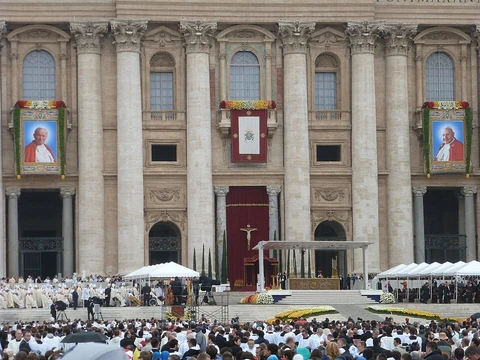
Peter Damian
Italian reforming Benedictine monk and cardinal, Doctor of the Church.

Peter Damian (Latin: Petrus Damianus; Italian: Pietro or Pier Damiani; c. 1007 – 21 or 22 February 1072 or 1073) was an Italian reforming Benedictine monk and cardinal in the circle of Pope Leo IX. He was declared a Doctor of the Church on 27 September 1828, and his feast day is 21 February. Dante placed him in one of the highest circles of Paradiso as a great predecessor of Francis of Assisi.
- born
- c. 1007, Ravenna
- died
- 21 or 22 February 1072 or 1073
- field
- Theology, canon law, monastic reform
- nationality
- Italian
- known_for
- Reforming Benedictine monk and cardinal, Doctor of the Church, advocate of cleri
Lore & Background
Peter was born in Ravenna around 1007, the youngest of a large but poor noble family. Orphaned early, he was ill-treated by an elder brother who employed him as a swineherd, but another brother, Damianus, an archpriest, took him to be educated. Adding his brother's name to his own, Peter studied theology and canon law at Ravenna, Faenza, and the University of Parma, becoming a famous teacher by about age 25. Around 1035, he gave up his secular calling and entered the hermitage of Fonte Avellana, where his fervor led to extreme self-mortification and severe insomnia. After recovery, he lectured to fellow monks and, at the request of Guy of Pomposa and others, lectured at neighboring monasteries. In 1043 he became prior of Fonte Avellana, remaining so until his death. He introduced stricter discipline, including flagellation, and founded subject-hermitages at San Severino, Gamogna, Acerreta, Murciana, San Salvatore, Sitria, and Ocri.
Reader's Guide
Peter Damian was a central figure in 11th-century church reform, closely watching the fortunes of the church from his cloister and corresponding with popes and emperors. He wrote extensively on theological and disciplinary issues, including the Liber Gomorrhianus against simony, concubinage, and sodomy, and the Liber Gratissimus defending the validity of ordinations by simoniacal clerics. As cardinal bishop of Ostia from 1057, he served as papal legate to Milan in 1059, where he confronted clergy who resisted reform and secured their submission to the Holy See. He also assisted Pope Alexander II against the antipope Honorius II and was legate to settle a dispute between Cluny and the Bishop of Mâcon. His insistence that philosophy must remain subservient to religion influenced later thought, and his tract De divina omnipotentia defended divine omnipotence while recognizing God's ability to act outside time. Pope Benedict XVI described him as 'one of the most significant figures of the 11th century, ... a lover of solitude and at the same time a fearless man of the Church, committed personally to the task of reform.'
Did You Know?
- Peter Damian was originally a swineherd for an elder brother before being rescued and educated by his brother Damianus, an archpriest.
- He introduced the practice of daily siesta at Fonte Avellana to compensate for fatigue from the night office.
- His tract Liber Gratissimus argued for the validity of ordinations by simoniacal clerics, a position that influenced church policy by the end of the 12th century.
- As cardinal bishop of Ostia, he was consecrated on 30 November 1057, after initially resisting the appointment.
- Pope Benedict XVI called him 'one of the most significant figures of the 11th century' and 'a fearless man of the Church, committed personally to the task of reform.'
Frequently Asked Questions
Who is Peter Damian?
Peter Damian was an Italian Benedictine monk born near Ravenna around 1007 who rose to become a cardinal and one of the 11th century's most vocal advocates for clerical and monastic reform. His feast day is celebrated on 21 February.
What was Peter Damian's main role in the Church?
He worked inside Pope Leo IX's circle to tighten Benedictine monastic discipline and push back against clerical corruption, producing influential writings on theology, canon law, and penance. His reform agenda helped lay groundwork for the broader Gregorian Reform movement.
How did Peter Damian's life end?
He died on 21 or 22 February, most likely in 1072 (some sources say 1073), while still actively engaged in his reform work. The slight uncertainty in the exact year has persisted among historians for centuries.
Why is Peter Damian important to Catholic history?
Pope Leo XII declared him a Doctor of the Church in 1828, acknowledging his lasting impact on theology and monastic life. Dante also ranked him in one of the highest spheres of Paradiso, treating him as a spiritual forerunner to Francis of Assisi.
What is Peter Damian's connection to other saints and popes?
He was a close ally of Pope Leo IX and a driving force behind the push for stricter clerical standards in the mid-1000s. Centuries later, Dante positioned him in Paradise as a great predecessor to St. Francis, linking two eras of monastic renewal.
More in Catholic Saints & Popes 1-24
Related in Catholic Saints & Popes
Links follow this subject's own source article.
Elsewhere in the Catholic Saints & Popes universe
Spotted an error? Know more?
This is a living reference — every entry is fact-audited, and reader corrections feed straight into our audit queue. Suggest an edit · See this site's audit record