Lazarus of Bethany
New Testament figure raised from the dead by Jesus.

Utilisateur:Djampa - User:Djampa · CC BY-SA 4.0
Lazarus of Bethany is a figure of the New Testament whose life is restored by Jesus four days after his death, as told in the Gospel of John. The resurrection is considered one of the miracles of Jesus. In the Eastern Orthodox Church, Lazarus is venerated as Righteous Lazarus, the Four-Days Dead. The Eastern Orthodox and Catholic traditions offer varying accounts of the later events of his life.
- field
- New Testament figure
- known_for
- Raised from the dead by Jesus four days after his death
- nationality
- Judean (from Bethany, near Jerusalem)
Lore & Background
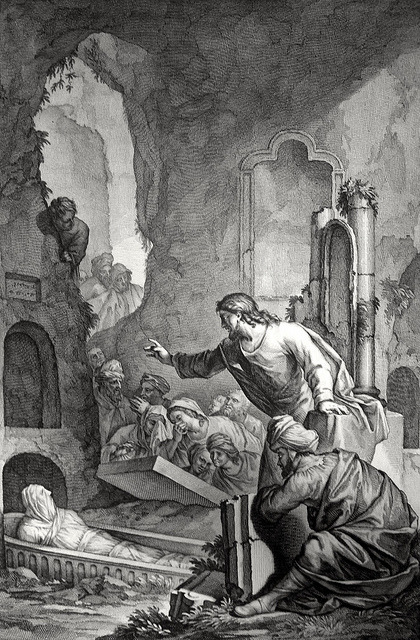
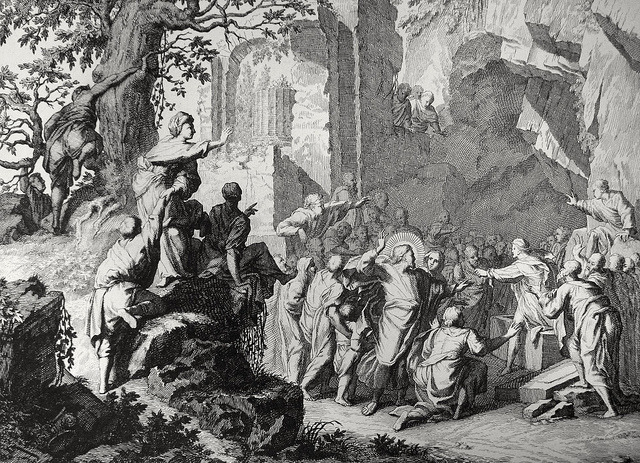
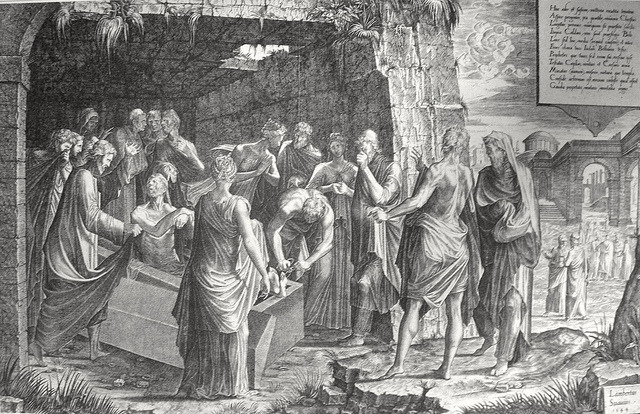
Lazarus of Bethany is introduced in the Gospel of John as a follower of Jesus and the brother of Mary and Martha. When Lazarus falls ill, his sisters send word to Jesus, who intentionally delays his journey for two days. By the time Jesus arrives in Bethany, Lazarus has been dead and entombed for four days. Jesus meets Martha and Mary, who lament that he did not arrive sooner. Jesus then goes to the tomb, has the stone rolled away, prays, and calls Lazarus out. Lazarus emerges still wrapped in grave-cloths, and Jesus instructs others to remove them. Many witnesses to this event believed in Jesus, while others reported it to religious authorities in Jerusalem. The Gospel of John mentions Lazarus again six days before the Passover, when he attends a supper served by Martha. The chief priests consider having Lazarus put to death because many people are believing in Jesus on account of this miracle.
Reader's Guide
The raising of Lazarus is the climactic narrative in the context of the seven signs in the Gospel of John, exemplifying Jesus' power over death. It is the last miracle Jesus performs before his passion, crucifixion, and own resurrection. The event directly leads to the decision of Caiaphas and the Sanhedrin to put Jesus on trial. Theologians view it as a pivotal miracle that starts the chain of events leading to the Crucifixion. The name Lazarus is frequently used in science and popular culture in reference to apparent restoration to life, such as the scientific term Lazarus taxon, the Lazarus sign, and the Lazarus syndrome. There is also a North Korean cybercrime gang called Lazarus Group. A distinct character of the same name appears in the Gospel of Luke in Jesus's parable of the rich man and Lazarus.
Did You Know?
- The name Lazarus is the Greek rendering of the Hebrew Eleazar, meaning 'God has helped'.
- The town of Bethany is today Al-Eizariya in the West Bank, Palestine, which translates to 'the place of Lazarus'.
- A resurrection story similar to that of Lazarus is found in the controversial Secret Gospel of Mark.
- The raising of Lazarus is the longest coherent narrative in the Gospel of John aside from the Passion.
The Miracle at Bethany
The raising of Lazarus stands as the longest continuous narrative in the Gospel of John outside the Passion account, and it serves as the final miracle Jesus performs before his own arrest and crucifixion. The story unfolds in Bethany, just outside Jerusalem, where Lazarus lives alongside his sisters Mary and Martha. When word reaches Jesus that the one he loves is sick, he does not rush to their aid. Instead, he deliberately stays where he is for two additional days before setting out, telling his frightened disciples that their friend has fallen asleep and that he is going to wake him. By the time he arrives, four days have passed and the body rests in the tomb. After consoling Martha and Mary in turn—prompting the brief narrator's note that Jesus wept—he commands the stone rolled away, offers a short prayer addressed to the Father for the benefit of the watching crowd, and calls out for Lazarus to come out. The man emerges still bound in burial wrappings, and Jesus instructs the onlookers to unwrap him and set him free. The event leaves many in the crowd believing, while others carry the news to the religious authorities in Jerusalem.
Theological Weight and Narrative Function
Within the architecture of John's Gospel, the raising of Lazarus functions as the seventh and climactic sign, demonstrating Jesus's sovereign power over what the text identifies as the final and most implacable foe of humankind: death. Theologians Moloney and Harrington describe it as a pivotal miracle that sets in motion the chain of events culminating in the Crucifixion, framing it paradoxically as a resurrection that leads to death—the death of the Son of God in Jerusalem, which in turn reveals the fullness of divine glory. The Catechism of the Catholic Church emphasizes that this miracle restored Lazarus to ordinary earthly life, paralleling the resurrections of the widow's son at Nain and Jairus's daughter. The narrative also explains the large crowds that gather around Jesus on Palm Sunday and directly precipitates the decision by Caiaphas and the Sanhedrin to put him on trial. A closely parallel resurrection story appears in the fragmentary Secret Gospel of Mark, where the young man is not named; some scholars argue this version preserves an earlier form of the tradition later expanded in John.
Echoes in Science, Culture, and Place
The name Lazarus has leapt far beyond the pages of scripture into scientific nomenclature, popular culture, and even geopolitics. In biology, the Lazarus taxon describes organisms that reappear in the fossil record after a long stretch of apparent extinction, evoking the image of a life seemingly lost being restored. Medicine borrows the same imagery in the Lazarus sign and the Lazarus syndrome, both referring to involuntary reflexive movements in patients who appear clinically dead. In the digital age, the North Korean state-sponsored cybercrime collective known as the Lazarus Group has adopted the name for its own operations. Literature and popular media have drawn on the figure repeatedly as a shorthand for miraculous restoration. The geographic footprint endures as well: the modern West Bank town of Al-Eizariya, widely identified with biblical Bethany, carries a name that translates directly as the place of Lazarus, anchoring the ancient story to a specific, living landscape.
Identity, Name, and the Question of Distinction
The name Lazarus is the Greek rendering of the Hebrew Eleazar, which carries the meaning that God has helped. The early Church Father Bede reflected on this etymology, noting that of all the dead whom Jesus raised, Lazarus was the one most helped, having lain dead for four full days before being restored to life. In the Eastern Orthodox tradition he is venerated under the title Righteous Lazarus, the Four-Days Dead, while Catholic and Orthodox sources offer differing accounts of what followed his resurrection. It is important to distinguish this Lazarus of Bethany from the eponymous beggar in Luke's parable of the rich man and Lazarus, a separate character who dies and finds himself in torment. The Bethany Lazarus is identified specifically as a follower of Jesus and the brother of Mary and Martha. In John's chapter twelve, he reappears at a supper in Bethany six days before the Passover at which Jesus is crucified; his very presence draws such crowds that the chief priests plot to have him killed, making him a direct target of the same authorities who will soon move against Jesus himself.
Gallery
Frequently Asked Questions
Who is Lazarus of Bethany?
Lazarus is a New Testament figure from the village of Bethany, near Jerusalem, best known as the man Jesus brought back to life. He was the brother of Mary and Martha, and his resurrection stands as one of the most famous miracles recorded in the Gospels.
How was Lazarus raised from the dead?
According to the Gospel of John, Jesus reached Bethany four days after Lazarus had died and been laid in a tomb. Jesus called out with a loud voice, and Lazarus walked out of the burial place still wrapped in his grave cloths.
Is Lazarus of Bethany venerated as a saint?
In the Eastern Orthodox Church he is honored as Righteous Lazarus, the Four-Days Dead, with a dedicated feast day. Both Orthodox and Catholic traditions also preserve varying accounts of what happened to him after his resurrection, though the details differ between the two.
Why is Lazarus's resurrection considered important?
The event is regarded as one of the greatest miracles of Jesus and a clear demonstration of his authority over death. It also functions as a powerful foreshadowing of Christ's own resurrection and anchors a major section of the Gospel of John.
Where was Lazarus from and what was his background?
Lazarus was a Judean native of Bethany, a small village situated just a short distance from Jerusalem. His family home was a regular stopping place for Jesus during his visits to that region.
More in Catholic Saints & Popes 1-24
Elsewhere in the Catholic Saints & Popes universe
Spotted an error? Know more?
This is a living reference — every entry is fact-audited, and reader corrections feed straight into our audit queue. Suggest an edit · See this site's audit record