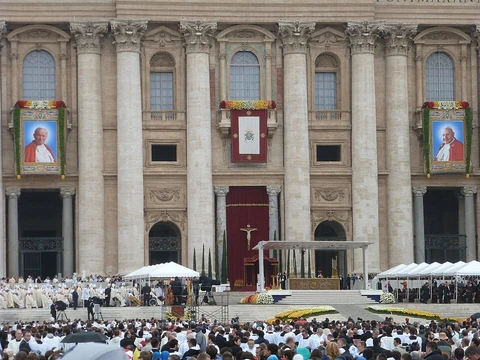
Peter Faber
Savoyard priest and co-founder of the Society of Jesus.

Peter Faber (13 April 1506 – 1 August 1546) was a Savoyard Catholic priest, theologian, and co-founder of the Society of Jesus, alongside Ignatius of Loyola and Francis Xavier. He was the first among the small circle of men who formed the Society of Jesus to be ordained, becoming a priest on 30 May 1534. Faber is remembered for his extensive travels across Europe on foot, his skill in guiding the Spiritual Exercises, and his gentle, personal outreach rather than theological debate. Pope Francis announced his canonization in 2013 via equipollent canonization, using a process that dispenses with standard judicial procedures for someone long venerated.
- born
- 13 April 1506, Villaret, Duchy of Savoy
- died
- 1 August 1546, Rome
- field
- Catholic priest, theologian
- nationality
- Savoyard
- known_for
- Co-founder of the Society of Jesus; first ordained among the early Jesuits; note
Lore & Background
Faber was born in 1506 to a peasant family in the village of Villaret, in the Duchy of Savoy. As a boy, he was a shepherd in the high pastures of the French Alps and had little education, but a remarkable memory: he could hear a sermon in the morning and repeat it verbatim in the afternoon for his friends. In 1525, he went to Paris and was admitted to the Collège Sainte-Barbe, where he shared lodgings with Francis Xavier. There he met Ignatius of Loyola and became one of his associates. Faber tutored Loyola in the philosophy of Aristotle, while Loyola tutored Faber in spiritual matters. Faber wrote of Loyola's counsel: 'He gave me an understanding of my conscience and of the temptations and scruples I have had for so long without either understanding them or seeing the way by which I would be able to get peace.' Xavier, Faber, and Loyola all became roommates at the University of Paris and are all recognized by the Jesuits as founders of the Society of Jesus. Faber was ordained a priest on 30 May 1534 and received the religious vows of Ignatius and his five companions at Montmartre on 15 August.
Reader's Guide
Faber's significance lies in his role as a foundational figure of the Jesuit order and as a model of gentle, personal evangelization. At the Diet of Worms and the Diet of Ratisbon in 1541, another Catholic theologian, Johann Cochlaeus, reported that Faber avoided theological debate and emphasized personal reformation, calling him 'a master of the life of the affections.' Faber was startled by the unrest the Protestant movement stirred up in Germany and decided the remedy lay in reform of the clergy, not discussions with Protestants. For ten months at Speyer, Ratisbon, and Mainz, he conducted himself with gentleness, influencing princes, prelates, and priests. He crisscrossed Europe on foot, guiding bishops, priests, nobles, and common people in the Spiritual Exercises. Faber kept a diary of his spiritual life known as his Memoriale, most of it dating from June 1542 to July 1543. It begins with a quotation from Psalms: 'Bless the Lord, O my soul, and forget not all his benefits.' He would ask the saint of the day and all the saints 'to obtain for us not only virtues and salvation for our spirits but in particular whatever can strengthen, heal, and preserve the body and each of its parts.' His travels helped establish the Society of Jesus in Portugal and recruit key figures such as Peter Canisius and Francis Borgia. Pope Francis announced his canonization on 17 December 2013, using equipollent canonization, and praised Faber's 'dialogue with all, even the most remote and even with his opponents; his simple piety, a certain naïveté perhaps, his being available straightaway, his careful interior discernment, the fact that he was a man capable of great and strong decisions but also capable of being so gentle and loving.'
Did You Know?
- As a boy, Faber could hear a sermon in the morning and repeat it verbatim in the afternoon for his friends.
- Faber was the first among the small circle of men who formed the Society of Jesus to be ordained, becoming a priest on 30 May 1534.
- He died reportedly in the arms of Loyola on 1 August 1546.
- Pope Francis announced Faber's canonization on his own 77th birthday, 17 December 2013, using equipollent canonization.
- Faber's diary, the Memoriale, begins with a quotation from Psalms: 'Bless the Lord, O my soul, and forget not all his benefits.'
Frequently Asked Questions
Who is Peter Faber?
Peter Faber (1506–1546) was a Savoyard priest and theologian born in Villaret, Duchy of Savoy, who became one of the three original co-founders of the Society of Jesus alongside Ignatius of Loyola and Francis Xavier. He is remembered as the first member of that early Jesuit circle to receive priestly ordination.
What was Peter Faber's specific role among the early Jesuits?
Faberserved as the group's primary spiritual director, guiding others through the Spiritual Exercises and modeling the personal, relationship-driven reform that the Jesuits championed. Rather than leading large-scale institutional projects, he focused on one-on-one pastoral care and quiet encouragement of fellow clergy.
How did Peter Faber spread the Jesuit mission across Europe?
He undertook extensive traveling circuits through France, Germany, and the Low Countries, visiting seminaries, courts, and monasteries to promote Catholic renewal. His itinerant ministry made him the Society's most visible face in the decades before the order received full papal approval.
How was Peter Faber canonized as a saint?
Pope Francis formally recognized Faber's sainthood in 2013 through the process of equipollent canonization, a rite reserved for those already venerated before the current Code of Canon Law took effect. No separate miracle investigation was required because of his long-standing popular devotion.
What made Peter Faber's approach to ministry distinctive compared to other Jesuit co-founders?
Where Xavier was known for global missionary expansion and Loyola for institutional architecture, Faber was celebrated for his gentle, non-confrontational style of personal outreach. He preferred quiet spiritual direction and relational persuasion over public theological debate, a trait that shaped the Jesuit emphasis on accompaniment.
More in Catholic Saints & Popes 1-24
Related in Catholic Saints & Popes
Links follow this subject's own source article.
Elsewhere in the Catholic Saints & Popes universe
Spotted an error? Know more?
This is a living reference — every entry is fact-audited, and reader corrections feed straight into our audit queue. Suggest an edit · See this site's audit record