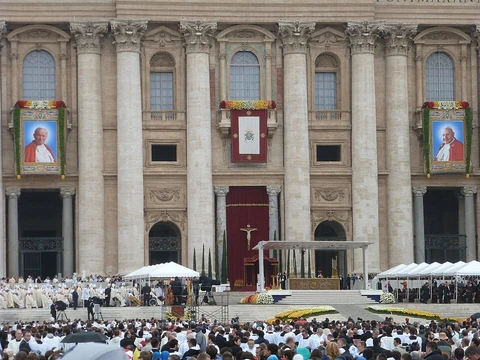
Pope Benedict XVI
Pope who resigned in 2013, first pope to step down since 1415.

He was the first pope to relinquish the office since Gregory XII quit the papacy in 1415 to help end the Western Schism. Benedict resigned at the age of 85, citing declining health due to old age. He chose to be known as "Pope emeritus" upon his resignation, and he retained this title until his death in December 2022.
- died
- 31 December 2022
- known_for
- Resignation as pope
Verified Timeline
Lore & Background
On the morning of 11 February 2013—the World Day of the Sick, a Vatican holy day—Pope Benedict XVI announced his intention to resign the Petrine Ministry effective 28 February 2013. The announcement was made at the Apostolic Palace, in the Sala del Concistoro, at a public ordinary consistory of cardinals that was being held to announce the date of the canonisation of 800 Catholic martyrs. Speaking in Latin, Benedict told mostly surprised cardinals and other attendees that he had made "a decision of great importance for the life of the church." He noted that the decision was made 'in full freedom'—that the resignation be voluntary is required by canon law. He cited his deteriorating strength due to old age and the physical and mental demands of the papacy. The news story was broken by journalist Giovanna Chirri, who understood Latin. Two days later, he presided over his final public mass: a service for Ash Wednesday that ended with congregants bursting into a "deafening standing ovation that lasted for minutes" while the pontiff departed St. Peter's Basilica. On 17 February 2013, Benedict, speaking in Spanish, requested prayers for himself and the new pope from the crowd in St. Peter's Square. Benedict XVI delivered his final Angelus on Sunday, 24 February. He told the gathered crowd, "Thank you for your affection. [I will take up a life of prayer and meditation] to be able to continue serving the church." The pope appeared for the last time in public during his regular Wednesday audience on 27 February 2013. By 16 February, 35,000 people had already registered to attend the audience. On the evening of 27 February there was a candlelight vigil to show support for Pope Benedict XVI at St. Peter's Square. On his final day as pope, Benedict held an audience with the college of Cardinals, and at 16:15 local time he boarded a helicopter and flew to Castel Gandolfo. At about 17:30, he addressed the masses from the balcony for the last time as pope. After this speech Benedict waited out the final hours of his papacy; at exactly 20:00 CET the see of Rome became vacant. The conclave to select his successor began on 12 March 2013 and on 13 March 2013 elected cardinal Jorge Mario Bergoglio, Archbishop of Buenos Aires, Argentina, who took the name of Francis.
Reader's Guide
After his resignation, Benedict took up residence in the Papal Palace of Castel Gandolfo. The Swiss Guard's service at Castel Gandolfo ended with Benedict's resignation; the Vatican Gendarmerie became solely responsible for the former pope's personal security. Benedict moved permanently to Vatican City's Mater Ecclesiae on 2 May 2013, a monastery previously used by nuns for stays of up to several years. According to Vatican spokesman Federico Lombardi, Benedict would not have the title of cardinal upon his retirement and would not be eligible to hold any office in the Roman Curia. On 26 February 2013, Father Lombardi stated that the pope's style and title after resignation are His Holiness Benedict XVI, Roman Pontiff Emeritus, or Pope Emeritus. In later years, Benedict expressed his desire to be known simply as "Father Benedict" in conversation. He continued to wear his distinctive white cassock, but now worn without the pellegrina, a traditional symbol of authority. Instead of the red papal shoes, he wore a pair of brown shoes that he received during a state visit to Mexico. Cardinal Camerlengo Tarcisio Bertone defaced the Ring of the Fisherman by chiseling two deep cuts in the shape of a cross, rendering it unusable as a seal. Benedict wore in his retirement a regular ecclesiastical ring. Benedict XVI lived in the monastery until his death 9 years later on 31 December 2022. He died there after having been ill for several days. After his funeral on 5 January 2023 in St. Peter's Square, he was buried in a tomb next to his predecessors underneath St. Peter's Basilica.
Did You Know?
- Benedict XVI was the first pope to resign since Gregory XII quit the papacy in 1415.
- He announced his resignation on 11 February 2013, the World Day of the Sick, a Vatican holy day.
- The news story was broken by journalist Giovanna Chirri, who understood Latin.
- On his final day as pope, Benedict boarded a helicopter at 16:15 local time and flew to Castel Gandolfo.
- Benedict chose to be known as 'Pope emeritus' upon his resignation and retained this title until his death.
Frequently Asked Questions
Who is Pope Benedict XVI?
Pope Benedict XVI, born Joseph Alois Ratzinger in 1927 in Germany, led the Catholic Church from 2005 until 2013. He was a deeply influential theologian and philosopher who spent his career defending traditional Catholic teaching before taking up the papal throne.
What made Pope Benedict XVI's papacy historically significant?
His voluntary resignation in 2013 made him the first pope to step down in roughly six hundred years, shattering a centuries-old precedent. That single act redefined how the Church understands the practical limits of papal authority.
What was Pope Benedict XVI known for beyond the papacy?
He was a prolific academic and author in theology and philosophy, producing a large body of scholarly and pastoral writing over several decades. Many in the Catholic world regarded him as one of the most important Catholic thinkers of the twentieth and early twenty-first centuries.
When did Pope Benedict XVI die and how did he spend his final years?
He died on 31 December 2022, just days after his 95th birthday. Following his 2013 resignation, he retired to the Mater Ecclesiae monastery within Vatican City, where he lived a quiet, contemplative life until his passing.
Why is Pope Benedict XVI considered important to Catholic tradition?
He is remembered as a rigorous guardian of orthodox doctrine during a period of intense theological and cultural debate. His decision to resign also demonstrated that a pope could set down his office for reasons of age and declining strength, opening a new chapter in papal history.
More in Catholic Saints & Popes 1-24
Related in Catholic Saints & Popes
Links follow this subject's own source article.
Elsewhere in the Catholic Saints & Popes universe
Spotted an error? Know more?
This is a living reference — every entry is fact-audited, and reader corrections feed straight into our audit queue. Suggest an edit · See this site's audit record